
History of EMHC
The European Magic History Conference
Idea, Significance, and Future
The European Magic History Conference (EMHC) was founded in 2005. Its point of departure was an initiative by Jacques Voignier and a circle of French collectors and magic historians who organised a meeting on the occasion of the 200th birthday of Jean Eugène Robert-Houdin—one that deliberately differed from magic conventions in the usual sense. From the very beginning, the focus was not on performance, not on tricks, and not on applause, but on the historical engagement with magic as a cultural phenomenon.
The basic idea behind these meetings was as simple as it was consistent: to bring together people who take a serious interest in the history of magic—collectors, historians, archivists, librarians, curators, and practising magicians—in order to exchange research findings, present sources, open up new perspectives, and make previously overlooked aspects visible. From the outset, the EMHC did not see itself as a club, nor as an institution with fixed hierarchies, but as a loose, international community of like-minded individuals, united by curiosity, respect, and shared interest.
Over the years, this idea developed into a regularly held conference that took place every two years in changing European cities: Paris, Berlin, Vienna, London, Hamburg, Turin, Ghent, and most recently Riga. Each of these events bore the personal signature of its respective organisers and at the same time reflected the local historical context. This is precisely where one of the great strengths of the EMHC lay—and continues to lie: no uniform procedures, but diversity; no standardisation, but individual approaches.
The significance of these meetings can hardly be overstated. The EMHC became a place where the history of magic is taken seriously—not as a nostalgic accessory, but as an independent part of cultural history. Lectures ranged from analyses of medieval visual sources to research into forgotten artists’ biographies, and on to studies of apparatus, posters, programmes, films, and archives. Many of these contributions led to further publications, exhibitions, or new research projects. In this way, the EMHC had an impact far beyond the individual meetings themselves.
At the same time, these conferences fulfilled a clear task: they helped to preserve cultural memory. Magic is an ephemeral art form; performances disappear, props are discarded, knowledge is lost. Without historical work, only legends and myths remain. The EMHC counters this with a well-founded, source-based approach. It makes clear that magic has always been embedded in social, political, and aesthetic contexts—and continues to be so today.
The status of magic history is shown precisely in its ability to build bridges: between theory and practice, between past and present, between scholarly analysis and personal passion. The EMHC was—and is—a space in which these different perspectives can exist side by side on equal footing. Not competition, but exchange defines its tone.
Engaging with the history of magic is not an academic game. It is a necessity. Anyone who wants to understand the present of magic must know its origins. Anyone who wishes to take new paths should be aware of those already taken. Historical research protects against repetition, clichés, and oversimplification—while at the same time opening up new creative possibilities. In this sense, the EMHC is not a backward-looking project, but a forum with a view toward the future.
The outlook for future meetings is therefore deliberately open. The EMHC is not a mass event and does not seek to become one. Its strength lies in its manageability, in personal exchange, and in trust in commitment rather than bureaucracy. As long as there are people willing to contribute their time, their knowledge, and their enthusiasm, there will also be future EMHC meetings. They will—just as before—continue to develop, set new accents, and remain true to what has defined them since 2005: thinking together, remembering together, and passing on knowledge together.
Or, to put it simply:
Our work will be spread by word of mouth.
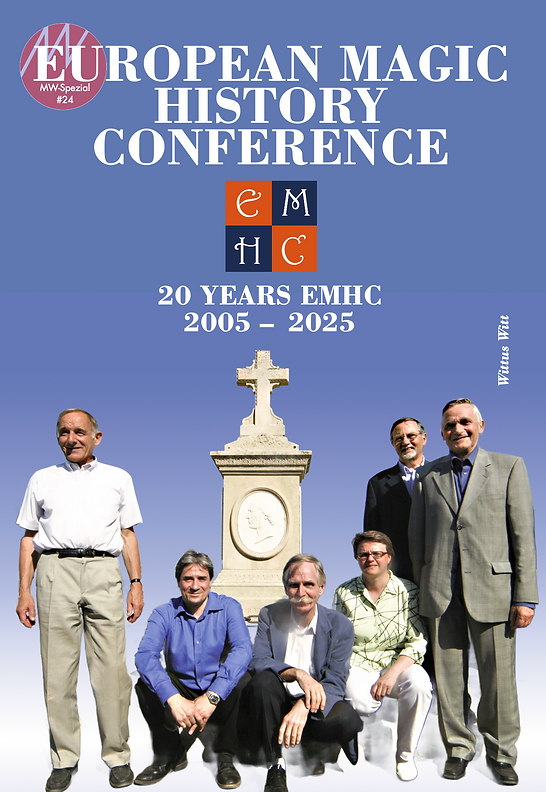
Click on image to download
20 years EHMC 2005-2025 by Wittus Witt
Get in Touch
Have inquiries or need more information?
Reach out to us via the contact form below, and our team will be delighted to assist you.